Sunday, January 26, 2014

You Got Spam!

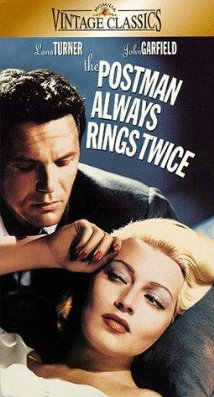
Three days before the U.S. Postal Service raised the price of a first-class letter and most other mail by three cents to 49 cents, the agency and the mail industry filed competing appeals of the rate increase in federal court. The USPS has been in trouble for a long time. Technology has changed the world, and for too many reasons to list here (political mostly) the Postal Service has been getting kicked around since 1946 (The Postman Always Rings Twice). The Postal Service has had one arm tied behind its back, not allowed to fight a fair fight.


Email and the Internet killed the Postage Stamp


Would you pay 1/10th of a penny to send and receive spam free email via the USPS? If you paid to send or receive email hosted and maintained by the USPS:

  • Spam would cease to exist. Period.
  • Malware and Viruses would never make it to your inbox. It would be safe, always.
  • If you send and receive 1000 emails per day, it would cost you $0.001 x 1000 x 365 = $1 per day to have spam-less, guaranteed delivery email. You can do your own math.
  • You could have “certified email” which would stand up in court, or via other legal venues. You could prove delivery of emails, with a receipt.
  • We trust the USPS with checks, with contracts, with everything. It makes sense that you would trust them with your email.
  • Tampering with the delivery of the US mail in any fashion is a big Bozo no-no. A Federal Crime. Why not extend that to USPS delivered email? [ See http://www.gpo.gov/fdsys/#  Chapter 83 - Postal Service]
  • All of the laws that cover your postal mail could cover your USPS email. Porn, online scams, all the nonsense.  No more emails from Nigerian Royalty.
  • You don’t have to force anyone to use the USPS for email. You can keep using Gmail, or Yahoo or any other service. But why would you? What is your time worth? Maybe use Gmail for the goofy stuff, but use the USPS email for things that matter.
  • Email via the USPS would make the USPS profitable. Very profitable.
  • You decide who you use to send a package overnight (FedEx, UPS, USPS). Why not have the same choice for your email provider?
  • If you buy Stamps online, you save money. They give you a discount. What if you used USPS for your email, and received an additional discount on other USPS services? Example: sign up for USPS email service, and get 10% off all other USPS services, like your PO Box fee or Stamps.


Personally, I love our local post office. I have a PO Box and they now accept FedEx and UPS, not just postal mail. They email me when there is new mail ready for me to pick up. I can take a trip, and never worry about my mail or deliveries. They hold my mail and packages. I feel that the level of service that I receive is outstanding, compared to the costs. I don’t want to see my USPS service go away or have them reduce any of their services due to a lack of funds.


Why not let the USPS compete fairly against FedEx and UPS? Why not let the USPS compete against Gmail and other “free” services? Again, if you send and receive 1000 emails per day, it would cost you $1 per day. I would gladly pay that to have a perfect, dependable, safe and secure business grade email account. 

And, it would save the Postal Service. What’s wrong with my logic?


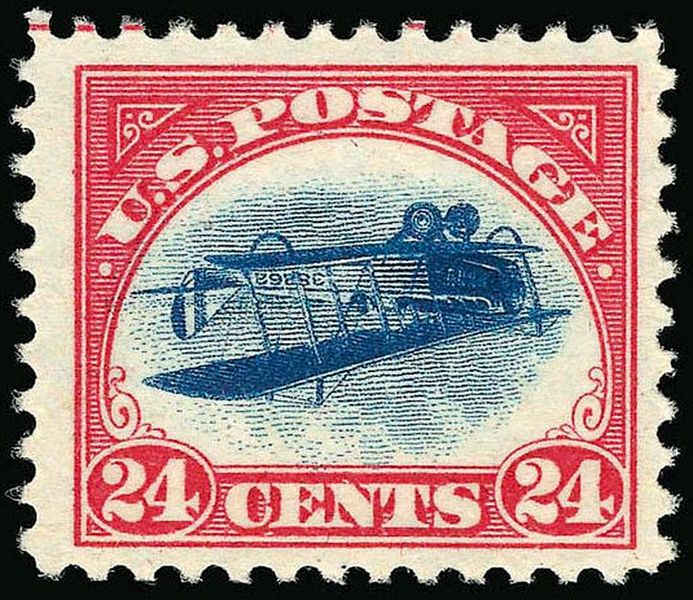
A single inverted Jenny was sold at a Robert A. Siegel auction
in November 2007 for US $977,500.

Sunday, January 5, 2014

Did you feed the dog?


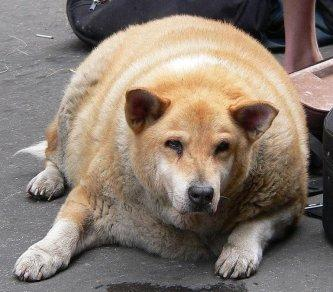
At our house, we now have two dogs - Bella - and our foster dog, Collin. Both dogs are fed twice day. One big dog, one little dog. We know that we have to keep the dogs separate during feeding, that is just common sense. We don’t want Bella eating Collin’s food, and we don’t want Collin eating Bella’s food. And we don’t want them to fight over food. It is not their fault, that is just hard-wired into their doggie DNA. After all, they are dogs.


Every day for years, we would hear someone shout out from the kitchen: “Did you feed Bella? Did anyone feed Bella? Do you know if Bella was fed?” Sometimes, we need to make a phone call: “Sorry to bother you, but do you know if Bella was fed?”


It did not really hit me until we started to foster dogs that this conversation happened in our house, twice a day, every single day for many years. We did not assume that Bella was fed - that would not be fair to Bella. She could easily get cheated out of a meal. And, giving her food more than twice a day would be unhealthy and it would cause her to gain weight. And if you offer a dog food, they will be happy to eat it. Her gaining weight would not be Bella’s fault. It would be ours.

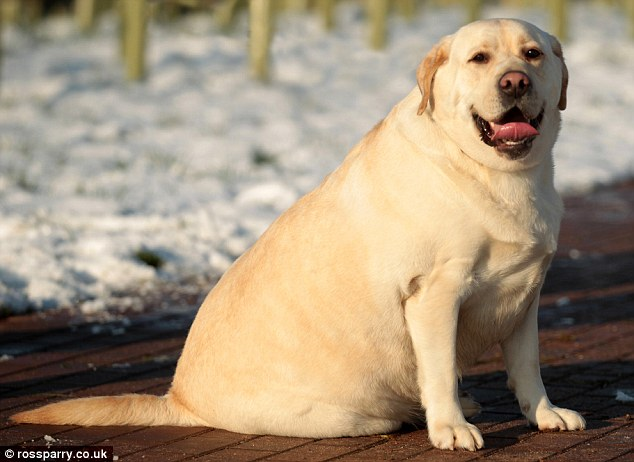
Obesity is a nutritional disease which is defined by an excess of body fat. Dogs that are over nourished, lack the ability to exercise, or that have a tendency to retain weight are the most at risk for becoming obese. Obesity can result in serious adverse health effects, such as reducing the lifespan, even if your dog is only moderately obese. Multiple areas of the body are affected by excess body fat, including the bones and joints, the digestive organs, and the organs responsible for breathing capacity.

So, without even thinking the same conversation would take place over and over. Was the dog fed. Was the dog fed. Better call your mother and find out if she fed the dog. We had no system, we just defaulted to the inefficient, mindless, redundant, duplicated conversations to poll the family to find out “was the dog fed” and then, the obvious follow up questions: “Are you SURE the dog was fed?” You better call and double check.


Enter our foster dog, Collin.


Now we have two different bags of dog food. Two different brands. Two food stations. Two water bowls. Big dog, little dog. Different food portions, different everything. And now, we also have a system.


The dog food bags have large “clips” on them, to keep the dog food fresh. The clips on the dog food bags tell us what we need to know. If the clip is placed at an angle like this: / then we know the dogs were fed for the morning. If the clip is placed at an angle like this: \ then we know that the evening meal was served. So, one only has to look at the clip; the clip has become like a sundial. The big clip does not just keep the dog food bag closed, it communicates important information. If it is evening, and the clip is still pointing to the morning position, it is safe to feed the dogs. If it is morning, and the clip is pointing to the morning position, this signals that the dog(s) were already fed. Or, one dog was fed, and the other dog was not fed. Brilliant.


Bella’s dog food bag had a clip on it for years, but it was always in this horizontal position: --- The clip was used to simply keep the bag closed, and nothing more. When there was only one dog, it was OK to just keep asking the same question multiple times a day like a bunch of morons: Did anyone feed the dog? Sorry to call you at work, but did you feed the dog? But now, simply having two dogs, we needed a system. Did you feed Bella? Did you feed Collin? Now we are going to have twice the number of phone calls - no, that was not going to work. Collin’s arrival at Camp Capone was the trigger, he was the muse. Collin’s arrival was the Mother of Invention. We needed a system, and a system we shall have!


In my company, I find myself working with people who live and are located all around the world. Did you (he, she, they) do it yet? Is it done? Is this now fixed? Was this taken care of? Did you call them back? Did you ship it?


I am the CEO, so the buck stops with me. Is this my life now - having to constantly ask people all around the world: did you do it, did you do it, did you do it? Is this done? Is this now done? OK, so NOW is this done? Are there not collaboration tools, online remote tools that would make asking such inefficient and redundant questions a thing of the past?


Of course there are such wonderful, magical collaboration tools! Ah, yeah boss. We actually sell them.


And so, we have today’s blog. As humans (not robots): first, we don’t realize that we need a system. Then, we realize that we indeed need a system. Then we realize that we need to actually USE the system.


If you don’t know that you have a problem (in life, at work, in business) you will never seek out a solution. That would be just nuts - it is out of sequence. But, once you recognize that you actually have a problem, once you “see the need” to seek out a possible solution, then the problem becomes impossible to ignore. Your mind will never allow you to un-ring that bell, or put that problematic genie back into the bottle. Once you see it, you cannot pretend you did not see it. Once seen, a problem in seek of a solution - a system - cannot be unseen.


But what if one simply “forgets” to adjust the clip” you say? What if you simply forget to put the clip back in the proper signaling position? What if you simply don’t know the dog food bag clip positioning system? What if you were never trained in the fine art of dog food bag clip placement? 

Gee, I wonder if training is available for dog food bag clip placement? Is there a support group for those who are dog food bag clip placement challenged? 

“My name is Ed, and I am a horizontal dog food bag clip placer.”

A system is not "a system" if it cannot be taught and learned. If it is indeed a system, it can be mastered. And systems can be improved upon. That is key to the entire system mastery concept. The ongoing improvement to the system itself is what makes it a system.


Once you have a system (in life, at work, in business) you can never go back to a life without a system. Not being trained on the system is not the same as ignorance of a system. Not being willing to be trained, and not seeking out the mastery of the system in question is not the same as not being aware that there is a system waiting for you to master it.


“Forgetting” to properly position the dog food bag clip, is not the same as not knowing - not being aware that there IS a proper dog food bag clip position.


You cannot force anyone to do anything that they truly do not want to do. But if they want to learn, if they want to fix a problem, if they want to grow and advance themselves in life and in their careers - you can give people who care to learn a system to follow.


“I did not know we had a system” is not the same as “I forgot to follow the system” or “Don't tell the boss, but I don’t like that system, so I don’t follow it” or any other unhelpful indigent comment like that. If you did not know there was a system, well then that is a valid excuse - once. All other subsequent excuses after that first one (in life, at work and in business) are lame by default.


Once you know there is “a system” that benefits yourself and others - once you know that there is a proper way to place “the clip” (in life, at work, in business) then it is your responsibility to do it as per the system. It is up to you to do the right thing, all the time, every time, no exceptions. Your dogs (and your family, co-workers and clients) are counting on you. Here’s to healthy dogs, and non-horizontal dog food bag clips everywhere.


Our foster dog, Collin.
Saturday, December 14, 2013

This blog is for the birds


Part One: Bird Feeders


The saying “for the birds” is an old one. Etymology: based on the idea that birds eat seed, which is not worth much.  So, something that is “for the birds” is deemed to be worthless or undesirable, without value.


This television program is for the birds. Winter weather is for the birds. “What do you think of the new software?”  I think it is for the birds - it won’t work.


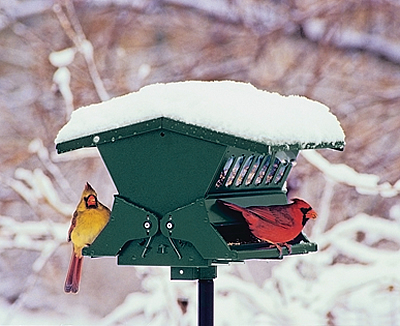
This year, we put up a bird feeder. Actually two, one that hangs from a tree, and one that sticks to a window in our den. I did not participate in these projects. So, when I first heard the noise at the window, I did not know what to think. And so came the conversation with my wife: “You know that once you put out the bird feeder, you have to do it all winter. Otherwise you will kill the birds.”


Excuse me?


It turns out, that if you put out a bird feeder, certain types of birds become dependent on that food for the winter. Certain breeds don’t live more than a small footprint from where they were born; they don’t migrate. So, if they find food - they become dependent on that local food source. If that local food source goes away, they are not capable of making the adjustment. They don’t know how to go find another source of food. So, putting out a bird feeder becomes a commitment. Doing it only a few times is actually more harmful than not putting out any food at all. If you are not going to feed the birds all winter long, you are better off not feeding them at all. Finish what you start, or don’t start at all.


I had to actually Google this, to see how many stories support this notion. There were many. Some birds can overcome this food / no food scenario. Others, not so much. Some breeds pass the point of no return. They stake out a source of food for the winter, and they are stuck with their decision. It is the little birdy version of crossing the rubicon. Now go Google “crossing the rubicon.”


Part Two: Sushi


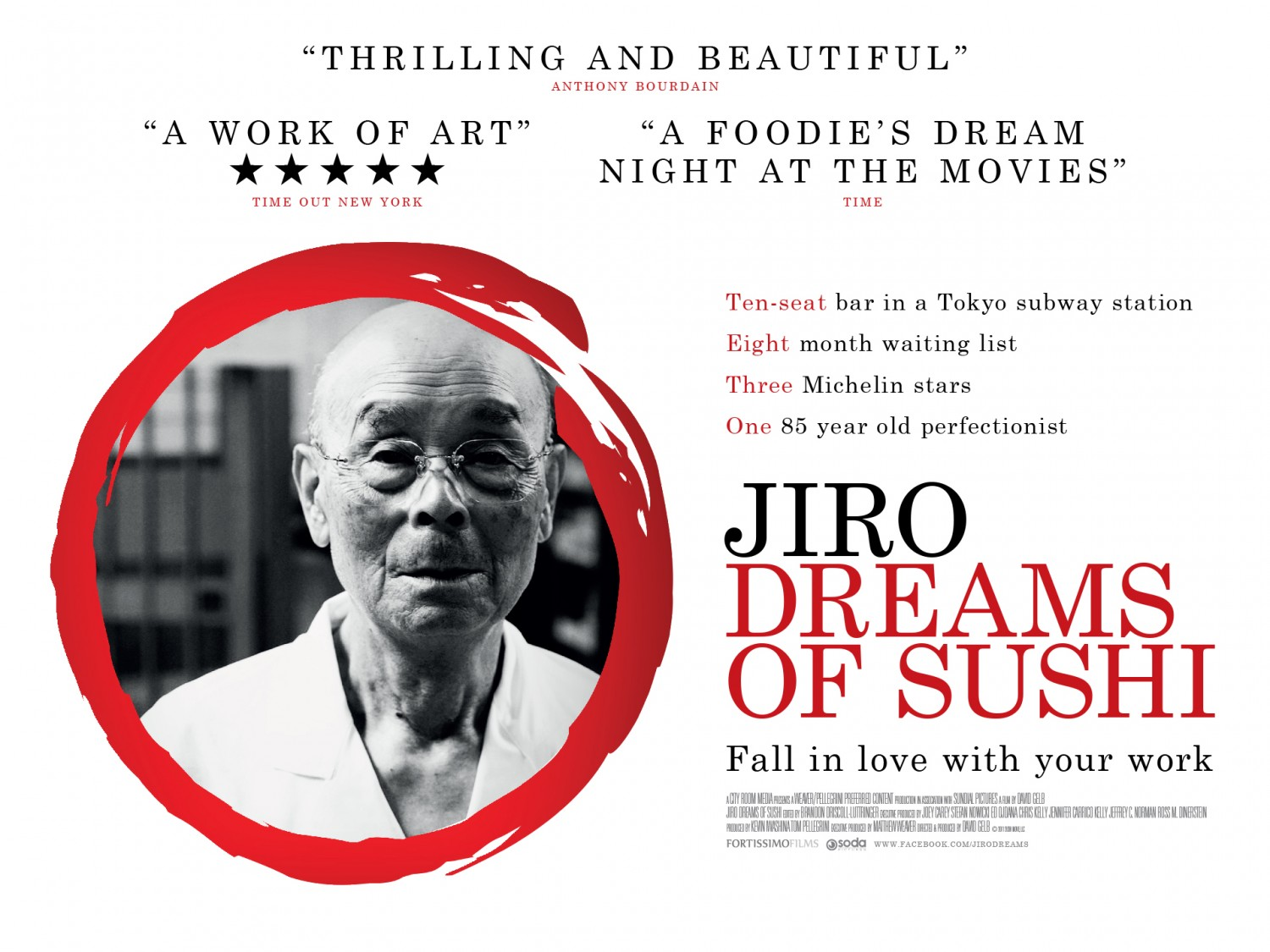
Jiro Dreams of Sushi is a 2011 American documentary film directed by David Gelb. The film follows Jiro Ono, an 85-year-old sushi master and owner of Sukiyabashi Jiro, a Michelin three-star restaurant, on his continuing quest to perfect the art of sushi. The film also profiles Jiro's two sons, both of whom are also sushi chefs. The younger son, Takashi, left Sukiyabashi Jiro to open a mirror image of his father's restaurant in Roppongi Hills. The 50-year-old elder son, obligated to succeed his father, still works for Jiro and is faced with the prospect of one day taking over the flagship restaurant.


My youngest son Bobby turned me on to this documentary. I watched it - twice. I think it should be required viewing by every business school. The film received very positive reviews from critics. The film earned a rating of 99% on Rotten Tomatoes based on 70 reviews and an average rating of 7.8/10, with the critical consensus saying, "Beautiful, thoughtful, and engrossing, Jiro Dreams of Sushi should prove satisfying even for filmgoers who don't care for the cuisine."  


While watching it, I found myself drawn into the mystery of this man. Are there any unrealized wishes in his life? Secret diversions? Regrets? If you find an occupation you love and spend your entire life working at it, is that enough? Standing behind his counter, Jiro notices things. Some customers are left-handed, some right-handed. That helps determine where they are seated at his counter. As he serves a perfect piece of sushi, he observes it being eaten. He knows the history of that piece of seafood. He knows his staff has recently started massaging an octopus for 45 minutes and not half an hour. Does he search a customer's eyes for a signal that this change has been an improvement? Half an hour of massage was not good enough; 45 minutes was much better. Jiro notices things.


Part Three: Finish What You Start

If you start feeding the birds, you must be committed to the task. Otherwise, your initial good deed turns into tragedy. You started out trying to do a good thing, but if you are not committed to the cause, you actually do more harm than good. Starting without the commitment to finish is a bad thing. How many people will start a business this year, especially an online business? How easy is it to turn up a website, making posts on social media, and open your little business to the world. How many people will “just do it” with the feeling that if things don’t work out, it is no big deal. You asked people to come to your store, but if they don’t you can just close it down. You might start a blog, and then stop. Not enough people are reading your words. No big deal. Or you might start a class and then drop out, as it's just not for you.


Finishing what you start is always within your power. No one can force you to do anything that you truly do not want to do. And, no one can prevent you from starting - and finishing - what you start out to do in life. There is a big difference from “quitting” and modifying your plan. Being “indifferent” is never a strategy that leads to success, unless your plan was to fail. Making mistakes, and learning from these mistakes is what makes life wonderful. If you must quit doing anything, let it be this: quit starting things that you had no intention of finishing. That’s just nuts. Modifying your plan: good. Not finishing what you start: bad.


Epilogue

Once you start down the road of being a parent, it never ends. There is no finish line; once the parenting journey begins it wonderfully never ends. There is no quitting being a parent. As your children get older, they will have their own experiences, and their own mistakes to make. They will have their own families, the own careers, and their own successes and failures. Do not let your children go through life with a cavalier attitude. Like Jiro, I have two sons - and they are very different. No matter what they do for a career, I can only hope that they find a little of Jiro's passion in their own lives. I’ll never stop trying to give my sons advice, but as my youngest son Bobby said to me:


“Dad, you have to check out Jiro Dreams of Sushi.”  


Something tells me that little birdy #2 left the nest when I was not looking. And I just noticed: it is time to go refill the bird feeder.


Sunday, December 1, 2013

Hey, no cuts!

I can predict the future, and I can prove it. Millions of people will purchase 12 month health club memberships on 01/02/2014. These savvy shoppers will go to their new health club a few times in January, never to return. And these same people will do it AGAIN every so many years (purchasing health club memberships - never using said health club memberships). Brilliant.
People will go to work on 12/02/2013 (tomorrow) and no matter what their company policy - these loyal employees will spend many hours online, shopping. Not working from their cubical, but shopping from their cubical. Heck, we have faster Internet at work, right?
If you want to predict future behavior, just look at past behavior. We all know this is true, it is common sense. But never in recorded history has it been easier to track human behavior, with “big data” and the power of the Internet. It is so easy to see the future. And even when you can clearly see the future (good or bad) we are powerless to change it.
Or are we?
Why will someone leave their warm cozy home to stand in line (in the cold) to get a “door buster” bargain on something that is going to be a gift for someone else? Why do corporations risk public ridicule opening their stores on what was previously a national holiday? If I sold fuel oil for your home at 25% off would you stand in line at midnight (in the cold) to grab that bargain?
As of this blog, the www.Healthcare.gov website has the following message:
The Health Insurance Marketplace online application isn't available from approximately 1 a.m. to 5 a.m. EST daily while we make improvements. Additional down times may be possible as we work to make things better. The rest of the site and the Marketplace call center remain available during these hours.
Now please, put your love / hate of the Affordable Care Act to the side for just a minute. Let’s just focus on the technology.
In the past 90 days, no website in the world has had more news coverage than www.Healthcare.gov.  This website has become the top news story. Because it did not work, it became news. It could not handle the traffic. The online store for health care was broken, and the best minds in the most technologically advanced country in the world could not make it work. One day, the eCommerce site for Obamacare will be the topic of discussion in major business schools, but for today, this eCommerce showcase site is still not ready for prime time. USA! USA! < sigh >
Because www.Healthcare.gov could not handle the traffic, the quick fix was to ask people to please log in during low traffic hours - please use the site in the early morning, or late at night. Please don’t use the site during typical high traffic hours. We simply cannot handle the demand, please work with us. Thank you.
< Insert hysterical laughter here >
Has no one heard of Cyber Monday? Black Friday? And now Brown Thursday? Humans are the most predictable of creatures. We will stand outside in the cold to get a Smartphone on sale. We will risk losing our jobs, shopping online while at work, challenging our bosses to try to stop us. What did you think would happen, when you asked people to come back and shop for health care during low peak hours? I am still laughing, are you?
I have seen people sleep overnight on sidewalks to get a new iPhone. I have seen people leave their warm, safe homes - leave their families and relatives that they only see once a year, to shop on Black Friday / Brown Thursday. These are the same people that you are asking to log in during low traffic hours. What were you thinking?
People want what they want -and they want it NOW!
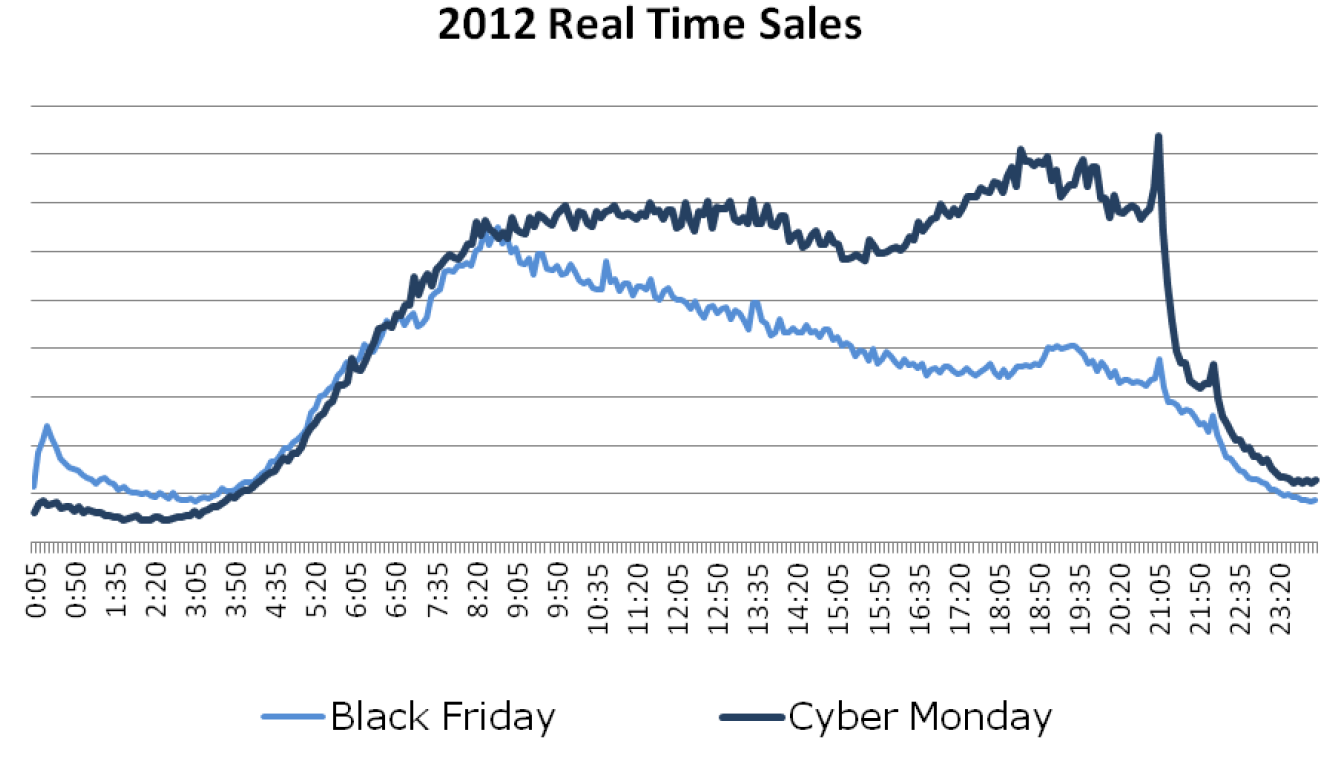
Everything below this line is from 2012. If you want it to be current and accurate for 2013, just add around 5% to these numbers. Maybe even 10%. Happy Shopping!
================================================
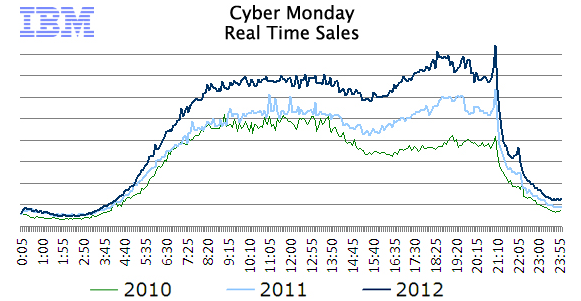
  • Big sales increase (again) – According to an IBM report, Cyber Monday sales increased by 30.3% compared to last year. The number of consumers shopping online peaked at approximately 11:25 AM EST with another strong peak later in the evening at approximately 9:10 PM EST. These peaks are likely due to the commuting patterns throughout the U.S. during traditional work hours as people shop once they get to work and when they arrive home.
  • Total sales may vary – According to Adobe, total sales reached $1.98 billion on Cyber Monday, a 17% increase from 2011. Analytics firm comScore also reported a 17% increase but a lower fiscal value at $1.46 billion in sales.
  • Mobile shopping soars – According to IBM, more than 18% of online shoppers used a mobile device to shop online on Cyber Monday 2012, an increase of over 70% from the previous year. Mobile sales accounted for approximately 13% of all sales for online retailers, almost double the amount of mobile sales on Cyber Monday 2011. The iPad dominated mobile traffic, surprisingly ahead of smartphone models, and accounted for over 90% of all tablet traffic to retail sites.
  • At-home shopping increases – Cyber Monday, since its inception in 2005, has been known as an online holiday for consumers to shop as they return to work on Monday after the long Thanksgiving weekend. According to comScore, for the first time ever, purchases made from at-home devices (up 4% in 2012 to 47.2%) surpassed purchases made from work devices (down 3.1% to 47.1%). This shift in shopping location is likely tied to the increased usage in mobile devices, especially at home during the early and late hours of Cyber Monday.
  • Consumers shop smarter – As online shoppers continue to spend more on Cyber Monday, they are also becoming smarter in regards to where their dollars are spent in order to take advantage of promotions such as free shipping. According to IBM, the average order value on Cyber Monday dropped 6.6% to $185.12, but the average number of items per order increased 14.1% to 8.34 items.
  • Pinterest leads social sales growth – According to Adobe, sales generated via Facebook and Twitter accounted for 77% for all social referral sales on Cyber Monday 2012, a percentage which is almost identical to Cyber Monday 2011. However, Pinterest was the big winner in the social media space this Cyber Monday with approximately 15% of social referral sales, a 105% increase from last year. Social referral sales from other social media sites (such as MySpace) fell to only 8%.
  • Cyber Monday is getting competition – In our preview post related to Cyber Monday 2012, we mentioned that Black Friday saw exceptional growth in online sales last year and could challenge Cyber Monday in the future as the biggest online shopping day of the year. According to comScore, Black Friday online sales surpassed $1 billion for the first time ever ($1.04 billion) with approximately 57.3 million Americans visiting at least one online retail site on Black Friday (an 18% increase from last year).  As more retailers develop multi-channel solutions it will likely become more common for these retailers to offer the same in-store promotions to their online audience.
—

Cyber Monday 2012 was yet another historic day for the online retail industry. With double digit sales growth and initial sales reports roughly in the $1.5 to $2 billion range it’s no surprise more records were once again broken this year. The major difference between Cyber Monday 2012 and previous years is primarily the exponential growth of mobile shopping, likely a key catalyst behind at-home sales overtaking workplace sales for the very first time. As the online retail industry continues to evolve, days such as Thanksgiving and Black Friday will likely continue to see strong online sales growth as multi-channel retailers continue to unify their online and offline promotions.

Sunday, November 17, 2013

Where were you when...


I was 3 years, 1 month and 20 days old when John F. Kennedy was Assassinated. I think this was my first memory. I was in the kitchen with my mother. She had the radio on and she heard the news. She screamed, and then she cried. I never saw my mother cry before. My father came home from work and she asked him “Did you hear?” I saw both of my parents so devastated. I remember that day like it was yesterday.


Less than one-third of us alive today, according to the U.S. Census, were here in 1963 when President John F. Kennedy's assassination plunged the country into grief, social re-assessment and a tailspin of conspiracy theories that persists 50 years later. Americans alive on that Nov. 22 day never forget.


JFK's murder, followed by the Oswald and Ruby fiascoes burned into the memories of those who were old enough to experience it. For older generations, like my parents and grandparents, it was yet another "Where were you on Pearl Harbor?" kind of day. For the young like me, we would not be able to process this until we were much older.


The Zapruder film is a silent, color motion picture sequence shot by private citizen Abraham Zapruder with a home-movie camera, as President John F. Kennedy's motorcade passed through Dealey Plaza in Dallas, Texas on November 22, 1963, unexpectedly capturing the President's assassination.


Though not the only film of the shooting, it has been called the most complete, giving a relatively clear view from a somewhat elevated position, and on the side from which the president's head wound is visible. It was an important part of the Warren Commission hearings and all subsequent investigations of the assassination, and is one of the most studied pieces of film in history. Of greatest notoriety is the film's capture of the fatal shot to President Kennedy's head when his limousine was almost exactly in front of, and slightly below, Zapruder's position.


Having a motion picture camera in 1963 was a big deal. They were expensive, and not easy to operate. Color film was expensive to buy, and even more expensive to develop.


During the Boston Marathon on April 15, 2013, two pressure cooker bombs exploded at 2:49 pm EDT killing 3 people and injuring an estimated 264 others. The bombs exploded about 13 seconds and 210 yards apart, near the finish line on Boylston Street.


There were thousands crowding the last stretch of the Boston marathon, all capturing the events before and after the bombs exploded.


The reality is with the number of people who are carrying with them the equivalent of HD video cameras, history is being documented by millions of people every day. In just over a decade, the amount of video being shot by amateurs has increased dramatically - and so too, has the evidence available to law enforcement officials.

Can you imagine back in JFK's day if you had the proliferation of cameras? There would be no question about the grassy knoll. We'd have answers on day two.


I was only 3 years old, and I remember exactly where I was and what I was doing when John F. Kennedy was killed. I remember exactly where I was when the Space Shuttle Challenger disaster occurred on January 28, 1986. And September 11, 2001. And when the Space Shuttle Columbia disaster occurred on February 1, 2003. And now, the Boston Bombings on April 15, 2013.


I wonder what our next “Where were you when” moment will be?


One thing's for sure, there will be video.