Sunday, March 26, 2017

The Power of 2 (or more)

"Hide not your talents. They for use were made. What's a sundial in the shade?" -- Benjamin Franklin


I love books. I am still a fan of “the paper book” as I like the feel of a real book. I like using bookmarks, and a highlighter to mark-up points to ponder. eBooks are cool too and serve a purpose. I have purchased eBook copies of my favorite paper books. Yep, all types of books are cool.


Two books that I highly recommend:  Power of 2 and StrengthsFinder.


I make it mandatory for all new hires (employees or contractors) to send me their StrengthsFinder report. The test comes free with the purchase of the book. The insights on a person’s true essence are spooky accurate. You cannot fake the results!


Do you have the opportunity to do what you do best every day?


Chances are, you don't. All too often, our natural talents go untapped. From the cradle to the cubicle, we devote more time to fixing our shortcomings than to developing our strengths.


To help people uncover their talents, Gallup introduced the first version of its online assessment, StrengthsFinder, in the 2001 management book Now, Discover Your Strengths. The book spent more than five years on the bestseller lists and ignited a global conversation, while StrengthsFinder helped millions to discover their top five talents.


In StrengthsFinder 2.0 Gallup unveiled the new and improved version of its popular assessment, language of 34 themes, and much more. While you can read this book in one sitting, you'll use it as a reference for decades.


Loaded with hundreds of strategies for applying your strengths, this Wall Street Journal, Businessweek, and USA Today bestseller will change the way you look at yourself -- and the world around you -- forever.


Power of 2 is a book that takes research from the Gallup organization and develops a theoretical model of eight factors that make up effective/ineffective partnerships: complementary strengths, a common mission, fairness, trust, acceptance, forgiveness, communicating, and unselfishness. The model is applicable to both work and personal relationships.

The authors present a blended approach to the content that makes it interesting and useful. They provide key statements for each factor along with examples that support their model. In addition, they provide specific strategies the reader may utilize in improving his/her own approach to developing and maintaining effective partnerships. It's one of those books that I call a re-read---you read it once and can't help but re-read at a later date to enjoy nuances and further learning on the ideas presented.


These are not new books, but they might be the core of my entire business philosophy. I am big believer that we should play to our strengths. And I have learned that true success - nothing of any value in the world of business - comes from a single individual.


  1. Play to your strengths, and empower your people to play to their strengths.
  2. None of us is as smart as all of us.


My StrengthsFinder report says that I might be (to some) impossible to work “for” but I can be amazing to work with.  

We are social creatures. So, we should all “play to our strengths" and always remember that life (and business) is a team sport. 

JoinNYDLA.org and I’ll send you these two books for free.

Sunday, March 19, 2017

The Obstacle is the Way

There is a very cool book by Ryan Holiday: The Obstacle Is the Way: The Timeless Art of Turning Trials into Triumph


I often give this book as a gift. It is my “go to” for anyone that works for me, with me, or anyone that I hope to work with. They say that you are who you spend the most time with. Well, I want to spend time with people who love this book. 

This book is a good read for getting over yourself, complaining, and doing something about your problems. I feel that this book was very practical, applicable (especially in today's society), and concise about stories of turning adversity into an advantage of examples from bad asses throughout history. Ryan does a great job of keeping the biographical examples brief and concise, then straight to the point of the lesson in each chapter. Ryan achieved what a lot of other authors who write about similar subjects, but better and more concise. It's an easy read and is a useful reminder for us all when we feel like the chips are down, that we can always flip the tables. It will definitely be a book I will always turn back to.


I recently witnessed “The Obstacle is the Way” in practice.  On March 10th - 12th the NYDLA.org was invited to observe as 9 regions, 5 continents, 1000 hackers & The UN SDG Action Campaign connect, create and collaborate during a 48-hour global hackathon around 3 of the UN Sustainable Development Goals.


Why now? For the first time in our history, we are at a point where we have the tools, ideas and technology to solve the world’s problems and have a real impact on the UN’s Sustainable Development Goals.
Why us? It has become commonplace thinking that government cannot and should not be expected to solve all our problems. Today it is up to us to work together to build the future we need. We must help the the UN achieve its goals.


Why get involved? The most successful businesses come from pain points. We want to create and build successful yet sustainable and responsible businesses that tackle real problems for genuine impact. All successful ideas will be put on a crowdfunding platform to facilitate their growth. There are a few quotes that I love. One quote is that “Mistakes are Tuition” in that we learn from our mistakes. We “paid” for that mistake - so why not get the full value of our investment? I expect my staff and colleagues to make LOTS of mistakes every day. If we are not making mistakes, are we not learning, and if we are not learning, we are not growing.
But the better lesson is that indeed: the Obstacle is the Way. Problems are the Purpose. To attack a problem is to live a full and passionate life. To take on the big hairy audacious goals to save the planet, to take on the problems that will lead to serving others, to make a difference in the world - what a gift. It is our problems that gives us our life purpose.


I spent 72 hours at Microsoft at 11 Times Square - watching the best and the brightest minds “attack” the world's problems. And living their passion in the process.

Now what? We can do this. We got this. There is NOTHING that we cannot accomplish if we all work together. The Obstacle is indeed The Way.


Sunday, February 19, 2017

Vote for the best liar

Image result for liar

People like politicians who give straight and honest answers, so why don’t they?


Here is my best guess: politicians who do not answer questions clearly and succinctly do this for a reason and are doing it quite consciously. But it is very unnatural behavior. In “real life” it is hard to get away with it in any other profession. And interestingly, voters seem to be turned off by it. So why do politicians keep evading questions?
The reason: they are actually in a difficult personal position. Of course they know the answers to the questions. But they are worried that if they give a straight answer, they will be crucified by party members and colleagues, or they think it might limit their flexibility in future decision making. So, they have many things to think of when giving an answer, and their calculation typically is that not giving an answer will give the best return. And many of them cannot think fast enough to answer in a safe manner.
The cognitive process going on inside a politician’s brain when evading answers is not straightforward. It takes training and mental control to answer this way. People who are impulsive would probably not be able to do it well. Part of the problems of many new grassroots politicians is that they often are somewhat more impulsively responding to questions. This meant that the party did not look like one with a united set of ideas. And this can lead to a number of scandals, and ultimately, a number of these people losing their elected positions.
Image result for bullshit meters
Only the people who are really good in saying what they think the party wants them to say and saying things that they think the public might want to hear will be able to stay in the political game. Not everybody is capable of this. There are special psychological traits and mental abilities that are important for being a politician.
Image result for bullshit metersBut, there is a big but! To really get to the top spot, to be the absolute leader (in a democracy) it is not enough to be good at evading answers and being able to stick to the party line. For those positions, the ultimate winner might be someone who is indeed giving straight answers. Straight answers that are not only straight answers, but also answers that reflect a vision that people want from a politician.
Now, once you are POTUS (or the top official) you should be above the fray. You should be able to freely state what you believe to be true, without any worries or consequences. Hell, you are POTUS! It should be liberating to know that you can say the truth, the whole truth, and nothing but the truth. YOU WON! Maybe, just maybe you are going to worry about being re-elected. So, maybe you feel that you need to continue to answer questions with half-truths.  But even if you don’t win a second term, hell, you were POTUS! 

Potus: feel free to tell the actual truth at all times, and let the chips fall where they may!
There is an old saying in politics: to change the world, first you need to get elected. So, politicians justify being evasive, hell, even flat out lying - so that they can get elected. And then once elected, they can make a difference.  In their minds, the ends justifies the means.
But Tom, you always blog about “technology” and the Internet and such? Where are you going with this?
Today, BECAUSE of the Internet, the speed at which a politician can be caught telling whoppers is nearly real-time.  We always knew that politicians lied, for the reasons stated above. Now, due to the ability to prove things false so fast, to check the facts almost instantly, our politicians come off as morons. As idiots. As unfit to serve.  
Where all of this will take us is anyone’s guess. But one thing is for certain; the speed of the Internet and the power of instant “fake news” has changed the game of politics forever. So don’t blame lying politicians; blame faster and affordable mobile Internet connections. Our politicians did not change, our technology did.

If a politician lied to get elected, we get that. We can see how the system works. But now that you are elected, cut the bullshit. You won, now go out into the world and do your job. Go forth and lie no more.
And these are not only facts, but these are “true facts” as they say in Washington.


Related image


Sunday, February 5, 2017

Where did you get those super balls?


Superballs: for the Super Bowl each year, there are 72 regulation footballs used in the big game. Each and every football is specially made just for the Super Bowl.


The 12 years between Ray Lewis's two Super Bowl victories are the longest between wins in any player's career.


Super Bowl 50 was the first big game to not feature roman numerals in its title. The NFL uses roman numerals to "clarify any confusion that may occur because the NFL Championship Game -- the Super Bowl -- is played in the year following a chronologically recorded season."


Many believe that Super Bowl Sunday should be its own holiday. Approximately 1.5 million people will call in sick to work the day after the big game.


Did you know the first two Super Bowls weren't even called by that moniker? It gained the name in the third Super Bowl. The first two were called the AFL-NFL World Championship Game. Catchy.


Behind only Thanksgiving, Super Bowl Sunday is the second largest day for food consumption in the United States.


Super Bowls are known for their commercials. In 2014, a 30-second ad has a price tag of $4.5 million. This year, $6.5 million.


Phil Simms, winner of Super Bowl XXI, was the first to ever say the phrase, "I'm going to Disney World!"


The average ticket price at Super Bowl XLIX was a cool $6,500. That is 110 percent more expensive than the previous year.


A flashy Super Bowl ring is not cheap. The jewelry costs approximately $5,000 each. A team usually gets around 150 for each Super Bowl victory.


The NFL might be an American sport, but Super Bowl Sunday is worldwide. The big game is broadcast around the globe in 34 different languages.


After his Colts defeated the Bears in Super Bowl XLI, Tony Dungy became the first African American coach to win a Super Bowl. The opposing coach, Lovie Smith, was also an African American.


On Super Bowl Sunday, Americans will drink an estimated 325.5 million gallons of beer and devour 1.25 billion chicken wings.


The first two Super Bowls were almost lost to soap operas. Back in 1967 and 1968, the big games were not broadcasted live, and the only known footage of them was thought to have been erased. (According to NFL Films' Steve Sabol, "they were erased to film soap operas.") Luckily, a single fan was found to have recorded the events, preserving the Super Bowls for posterity.


The Patriots' last-second victory over the Seahawks in Super Bowl XLIX was the most watched telecast in television history. The 49th Super Bowl was viewed by 114.4 million viewers.


More fun facts:


  • This is my tenth year of blogging about the Super Bowl on Super Bowl Sunday.
  • If you are reading this blog, you have access to “The Internet”
  • In 2015, the International Telecommunication Union estimated about 3.2 billion people, or almost half of the world's population, would be online by the end of the year. Of them, about 2 billion would be from developing countries, including 89 million from least developed countries.
  • In 2017, the number is closer to 4 billion.
  • So, therefore, BILLIONS of people could watch the Super Bowl today from a TV, smartphone, laptop, tablet - if they were so inclined. Or they could be watching Netflix. Or a TED.com talk. Or receive a tweet from the President of the United States. Or, they can enroll in an online class.


When we really, really want something, the universe conspires for it to come true.


I was born in 1960. My dad was friends with a man by the name of Leon Hess, the founder of the Hess Corporation and the owner of the New York Jets. On January 12, 1969 my dad took me to Super Bowl III at the Orange Bowl in Miami, Florida. To this day, this game is regarded as one of the greatest upsets in American sports history. The heavy underdog American Football League (AFL) champion New York Jets defeated the National Football League (NFL) champion Baltimore Colts by a score of 16–7. This was the first Super Bowl victory for the AFL.

If the NY Jets never won that game, the “Super Bowl” might have never become - super. And I would have ten less blogs in my archive.


NOW: why 72 balls you ask? Scroll up. Why 72 regulation “Superballs” and not 70? First 10 people who email me with the right answer shall win a $25 gift card. Seriously, I have ten $25 Amazon Gift Cards looking for new homes.


Ah yes, the power of the Internet.


If you are reading this blog, you have all the power you need to get the answer. When we really, really want something, the universe conspires for it to come true.


Sunday, January 8, 2017

The Invisible Putin

I received this cool book “The Invisible Gorilla” for Christmas. It is not a new book, but it was new to me.


Reading this book will make you less sure of yourself, and that's a good thing. In The Invisible Gorilla, they discuss a wide assortment of stories and counter-intuitive scientific findings to reveal an important truth: Our minds don't work the way we think they do. We think we see ourselves and the world as they really are, but we're actually missing a whole lot.


The authors took the combined work of other researchers with their own findings on attention, perception, memory, and reasoning to reveal how faulty intuitions often get us into trouble. In the process, they attempt to explain:


  • Why a company would spend billions to launch a product that its own analysts know will fail
  • How a police officer could run right past a brutal assault without seeing it
  • Why award-winning movies are full of editing mistakes
  • What criminals have in common with chess masters
  • Why measles and other childhood diseases are making a comeback
  • Why money managers could learn a lot from weather forecasters


Again and again, we think we experience and understand the world as it is, but our thoughts are beset by everyday illusions. We write traffic laws and build criminal cases on the assumption that people will notice when something unusual happens right in front of them. We're sure we know where we were on 9/11, falsely believing that vivid memories are seared into our mind with perfect fidelity. And as a society, we spend billions on devices to train our brains because we're continually tempted by the lure of quick fixes and effortless self-improvement.


The Invisible Gorilla reveals the numerous ways that our intuitions can deceive us, but it's more than a catalog of human failings. In the book they explain why people succumb to these everyday illusions and what we can do to inoculate ourselves against their effects. In short, the book attempts to give a sort of "x-ray vision" into our own minds, with the ultimate goal of helping us to notice the invisible gorillas in our own life.


http://www.theinvisiblegorilla.com/videos.html  You can see many video examples of the Invisible Gorilla here. If you watch these videos, you might begin to understand why we see (or don’t see) the obvious in the world around us.


Even when the obvious can kill us, even when the obvious is right in front of our own two eyes, we cannot see it. Wow, how did we ever make it this far as a species?


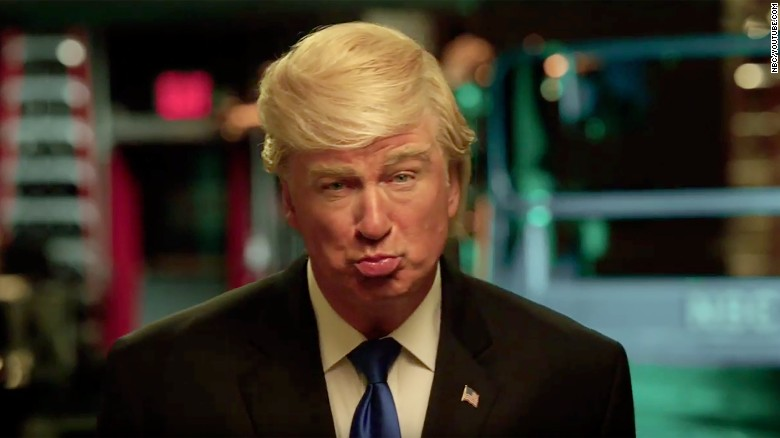
Alec Baldwin portrays Donald Trump on "Saturday Night Live"