Sunday, January 8, 2017

The Invisible Putin

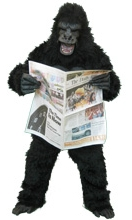
I received this cool book “The Invisible Gorilla” for Christmas. It is not a new book, but it was new to me.


Reading this book will make you less sure of yourself, and that's a good thing. In The Invisible Gorilla, they discuss a wide assortment of stories and counter-intuitive scientific findings to reveal an important truth: Our minds don't work the way we think they do. We think we see ourselves and the world as they really are, but we're actually missing a whole lot.


The authors took the combined work of other researchers with their own findings on attention, perception, memory, and reasoning to reveal how faulty intuitions often get us into trouble. In the process, they attempt to explain:


  • Why a company would spend billions to launch a product that its own analysts know will fail
  • How a police officer could run right past a brutal assault without seeing it
  • Why award-winning movies are full of editing mistakes
  • What criminals have in common with chess masters
  • Why measles and other childhood diseases are making a comeback
  • Why money managers could learn a lot from weather forecasters


Again and again, we think we experience and understand the world as it is, but our thoughts are beset by everyday illusions. We write traffic laws and build criminal cases on the assumption that people will notice when something unusual happens right in front of them. We're sure we know where we were on 9/11, falsely believing that vivid memories are seared into our mind with perfect fidelity. And as a society, we spend billions on devices to train our brains because we're continually tempted by the lure of quick fixes and effortless self-improvement.


The Invisible Gorilla reveals the numerous ways that our intuitions can deceive us, but it's more than a catalog of human failings. In the book they explain why people succumb to these everyday illusions and what we can do to inoculate ourselves against their effects. In short, the book attempts to give a sort of "x-ray vision" into our own minds, with the ultimate goal of helping us to notice the invisible gorillas in our own life.


http://www.theinvisiblegorilla.com/videos.html  You can see many video examples of the Invisible Gorilla here. If you watch these videos, you might begin to understand why we see (or don’t see) the obvious in the world around us.


Even when the obvious can kill us, even when the obvious is right in front of our own two eyes, we cannot see it. Wow, how did we ever make it this far as a species?


Alec Baldwin portrays Donald Trump on "Saturday Night Live"

Sunday, January 1, 2017

Different is better

I don’t think there are better jobs. In fact, the word “better” is a wiggle word. When someone who works for me tells me “I’ll do my best” what exactly are they are trying to say to me? How in the world could anyone ever know if this was “their best” work? And why would anyone ever knowingly do LESS than their very best work?


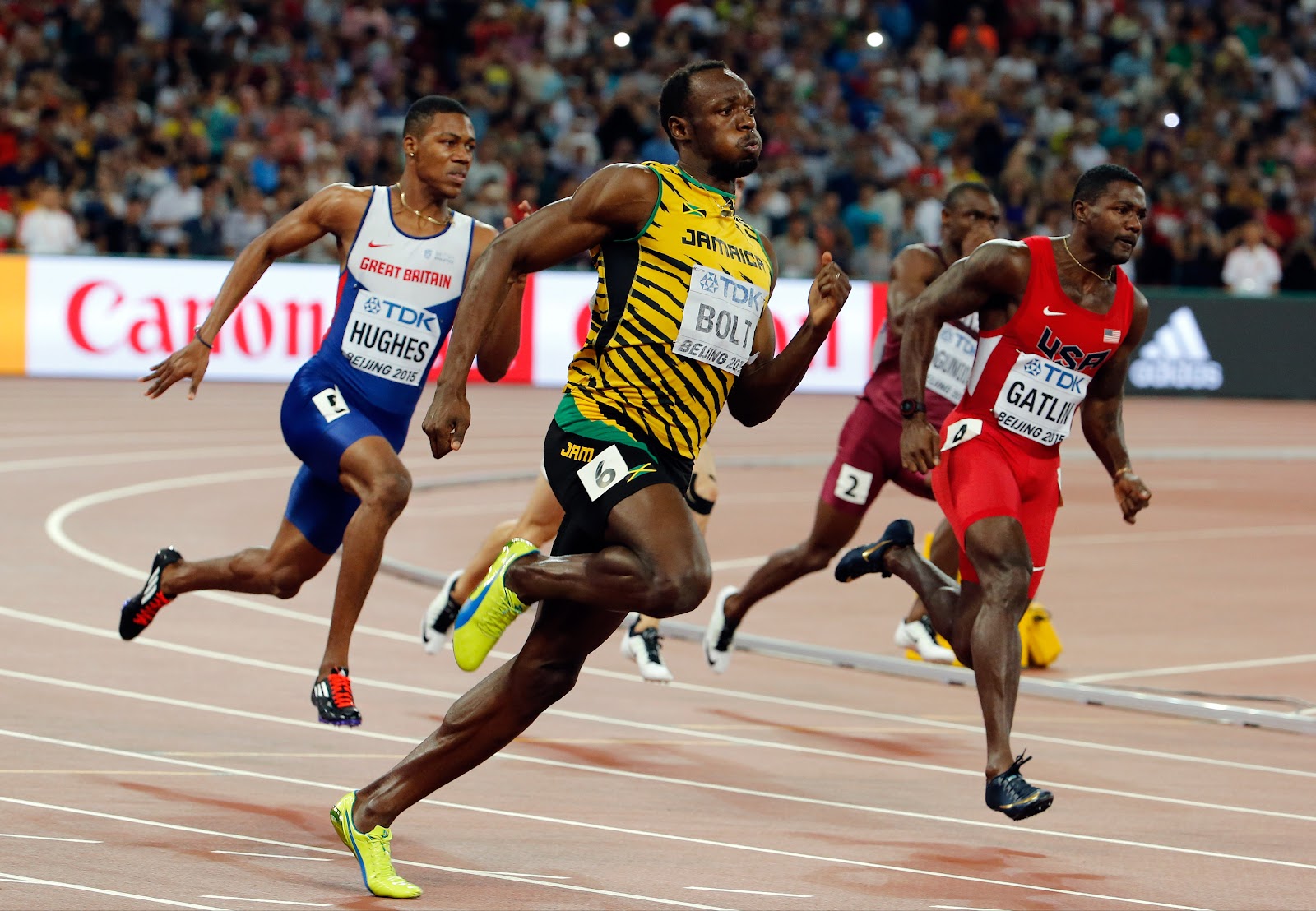
Let’s look at the world of sports. Usain St Leo Bolt, OJ, CD (born 21 August 1986) is a Jamaican sprinter. Regarded as the fastest human ever timed, he is the first man to hold both the 100 metres and 200 metres world records since fully automatic time became mandatory. He also holds the world record as a part of the 4 × 100 metres relay. He is the reigning World and Olympic champion in these three events. Due to his unprecedented dominance and achievements in the athletic field, he is widely considered the greatest sprinter of all time.  If it were you life’s mission to be BETTER than Usain Bolt, you have created a massive problem for yourself. Look at this picture - see the other men? These are some of the fastest men on the planet - do you know any of their names?


Name some of the top computer brands: Apple, Dell, HP, Asus, Lenovo, Acer, Toshiba, Samsung. There is a very good chance that you own a computer made by one of these brands. Is one company better than the other?


If you worked at Apple vs. HP vs. Lenovo vs. Acer (vs. any brand) does this mean that your life’s work will be judged by “the brand” that provides your paycheck? If it so hard to truly tell what brand of computer (or car, or smartphone, or anything) is “better” than the next brand, think of how difficult it would be to compare A JOB working at any one of these companies? Why would someone work for LESS money - but choose to work for Apple? It happens all the time. MONEY (compensation) is indeed a factor. But money is not the only factor.


Does anyone remember when Bo Jackson turned down $7M+ to play baseball for $1M? Vincent Edward "Bo" Jackson is a former baseball and American football player. He is one of the few athletes to be named an All-Star in two major sports, and the only one to do so in both baseball and football. 


Name the “Top Ten” comedians of all time. Did your list include Jerry Seinfeld? George Carlin? Louis C.K.? Robin Williams? Chris Rock? Bill Cosby? Did your list include any women such as Ellen DeGeneres? Based on what criteria? Why would “your list” be so different than mine?


I’ll keep this blog short today, since it is New Year’s Day and all. But here is something that you should ponder if you are indeed thinking about getting “a better job” in 2017.


Better - how? More money for less hours? Safer working conditions? Better benefits? How are you going to measure this elusive thing called “better” in 2017 and beyond?


Remember a very fast man by the name of Carl Lewis? How about Michael Johnson? At one time, Johnson held two world records. How about Jesse Owens? Owens won the Berlin Games, the 100 in 10.3 and the 200 in 20.7. Not impressive times until you consider that they were ran in 1936 in dirt. You put Owens on a synthetic track, with blocks, weight training and lighter spikes, he would easily run much faster. Maybe he would still be “the fastest man on earth”.


So, even when you can MEASURE things, down to a fraction of a second, being “better” still becomes relative. Better is hard to measure. And the better you get, the harder it is to measure. Oh how it must sting to NOT be the fastest man on earth, because you were 1/100th of second slower - someone is BETTER than you!  


But different - being different is very easy to measure. If I ask who is the fastest man on earth, you look to a stopwatch for the answer (and track condition, and indoor vs. outdoor, etc.).  If I ask who is the funniest person on earth - now what do you do? How does one measure such a thing? Money? Andrew Dice Clay is an American comedian and actor. He came to prominence in the late 1980s with a brash, macho, and offensive persona of "The Diceman". In 1990 he became the first comedian to sell out Madison Square Garden two nights in a row. He was: different.


I say: it is better to be different than to be better.


And YOU can control being different. When something is DIFFERENT, you know it immediately. You can feel it Instantly. You don’t measure being different with a stopwatch or via a tax return.


Now, if you have a TERRIBLE job with a TERRIBLE boss, and have unsafe working conditions - you did not need to read this blog to tell you to get the hell out of there. But, here is how you can tell if you have found (or already have) “a better job” in the New Year:


At work: are you rewarded for being different, or for being better? In 2017 try to measure your job not by money, or benefits, or the classic career metrics. How does your job make you feel? And this works for Entrepreneurs as well - since you are the boss of you.


I can pick “different” out of a crowd in a second. Better? Not so much. But I can honestly say that this was MY BEST BLOG of 2017. And that is indisputable.


Sunday, December 18, 2016

Winter Wonderland

Mount Everest, also known in Nepal as Sagarmāthā and in China as Chomolungma, is Earth's highest mountain. Its peak is 29,029 feet above sea level. Mount Everest is located in the Mahalangur mountain range in Nepal.


Death Valley National Park comprises more than 3.3 million acres of spectacular desert scenery, rare desert wildlife, complex geology, undisturbed wilderness and sites of historical interest. Death Valley is unique because it contains the lowest, hottest, driest location in North America. Nearly 550 square miles of its area lie below sea level. Ecologically, its plants and animals are representative of the Mojave Desert.
Death Valley is one of the hottest places on earth, attaining the highest temperature ever recorded, 134 degrees F. in 1913. It contains the lowest point in the western hemisphere -- 282 feet below sea level near Badwater -- as well as numerous high-rising mountain peaks, including Telescope Peak at over 11,000 feet. Death Valley was named by gold-seekers, some of whom died crossing the valley during the 1849 California gold rush.


If you are looking for an amazing place to visit this holiday season, The Winter Village at Bryant Park will do the trick. You can click here to see a live webcam of the Winter Village. Bryant Park is in the heart of Manhattan, an amazing place anytime of the year - but especially during the holidays.

The Rink is the centerpiece of Bank of America Winter Village at Bryant Park. The 170' x 100' rink features free admission ice skating, in addition to high quality rental skates, skating shows, special events, and activities. Whether you are looking to skate before going to the office, with family on weekends, or for a spin under the stars at a holiday party, Winter Village is the perfect destination.


Members of the NYDLA.org gathered at Bryant Park this past Friday for a holiday celebration. Many of NYDLA's vendors and sponsors had “pop up” stores in the Winter Village. Holidays in New York are always amazing, but the Winter Village at Bryant Park is really something special. The lines were long to check out Facebook's Virtual Reality. NYDLA members has special "front of the line" passes. 

Via VR, there were "virtual tours" of amazing destinations around the world - including Mt. Everest and Death Valley.


The next day, one homeless man shot and killed another early Saturday morning near Bryant Park. Terrance Walker, 27, was gunned down at about 2:20 a.m. at the busy corner of West 40th Street and Sixth Avenue in Midtown. Walker and another man argued as they left a nearby subway station. It was unclear late Saturday why the men feuded.


This was the scene early Saturday morning at the corner of West 40th St. and 6th Avenue. It was grim. Someone pulled a .38-caliber handgun and fired four shots. One bullet struck Walker in the chest. He collapsed to the pavement. Walker was declared dead at the scene. His attacker was last seen fleeing west on West 40th Street. The gunman was still on the lam late Saturday. He is described as 6 feet tall and about 190 pounds, and was wearing a black leather jacket over a blue hoodie. Police are confident security cameras will give them a glimpse of the suspect. “You’re by Bryant Park. Everything is on video. You’re gonna get caught,” a police source said. 

Later yesterday afternoon, as the park brimmed with shoppers perusing the annual Winter Village pop-up shops, some visitors were shocked a fatal shooting occurred just across the street, just a few hours ago. 

New York City during the holidays. Whether you visit in-person or via Virtual Reality - there is no place like it on earth.
I always wondered what it would fee like to go from Mt. Everest to Death Valley in less than 24 hours, virtually or otherwise. 

Real life or virtual reality, life is short. Every magical moment is precious.

Sunday, December 4, 2016

Tree envy


Today we killed a tree and then we dragged it into the house. And I was an accomplice.

There are few debates more lively and spirited than that age old argument about which type of Christmas tree is “better”: real trees, or artificial trees. Ever since the first feather Christmas trees were developed in the late 19th century, a serious divide has developed between those who swear by real Christmas trees, and those who prefer artificial trees. These debates have produced a number of untruths about both types of trees that are still widely believed, and make it more difficult for families to make an informed decision about what type of Christmas tree is best for them.

Coming off the recent election, I felt the need to get the facts. The “true facts” as they say in Washington, D.C.  So, via the power of “the Google” here are the facts. The true facts.

ARE REAL CHRISTMAS TREES CUT DOWN FROM FORESTS?
A small number of wild trees are cut down and used as Christmas trees. However, this type of removal is strictly regulated by the U.S. Forest Service, which limits the number of trees that can be removed. The remainder of such trees are cut down on private land by individuals who prefer to cut down their own Christmas trees.

The majority of Christmas trees are grown on farms (much like any other crop) specifically for the purpose of being harvested for Christmas trees. These trees wouldn’t exist in the first place, if it wasn’t for the public demand for Christmas trees.

ARE ARTIFICIAL CHRISTMAS TREES HARMFUL TO THE ENVIRONMENT? DO THEY CONTRIBUTE TO GLOBAL WARMING?
A consulting company that studies environmental sustainability in numerous industries, did an analysis of the environmental impact of artificial Christmas trees, versus real trees. The study found that, depending on how a real tree is disposed of, an artificial tree would only have to be used for more than 4 years before there was a net benefit with regard to contribution to global warming. This means that if a household uses an artificial tree for at least 4 years, its carbon footprint will be smaller than that of a household that purchases a real tree every year.
In addition, the study found that with both real and artificial trees, no matter how they were ultimately disposed of, Christmas trees accounted for less than 0.1% of the average person’s annual carbon footprint. So, the environmental impact is negligible, and can easily be offset by other lifestyle changes, such as driving less, recycling more regularly, purchasing items that use less packaging, etc.

DO REAL CHRISTMAS TREES TRIGGER ALLERGIES?
Plant-related allergies are typically triggered by the pollen produced by such plants. This is why spring is often referred to as “allergy season,” as the burst of warm weather in April and May triggers the reproduction cycle in many plant species, including tree species commonly used as Christmas trees. But by late November and early December, when such trees are harvested, pollen production has long since ceased. This means that most people with pollen allergies will not be bothered by real trees, except for those are sensitive enough to be bothered by trace amounts.

However, real trees can carry dust, as well as molds and fungi. The best way to deal with this is by cleaning the tree before you bring it into your home. Use your garden hose to spray down the tree, and then leave the tree somewhere warm to dry for about 24 hours. Once it’s dry, then you can bring it into your home. As an added precaution, you can try running an air purifier in the room where the tree is located. { Sounds like…….work }

Additionally, there is a very small percentage of the population that is allergic to tree sap. In this case, the only solution is to only purchase artificial trees for your home, and avoid close proximity to real Christmas trees. { And yet people will STILL do it!!!! Crazy, right??? }

ARE ARTIFICIAL CHRISTMAS TREES “TRADITIONAL”?
The “real tree” fans look at artificial trees with a cynical eye and consider them to be a sign of the commercialization of Christmas. However, Christmas trees as a whole were a relatively late fad in the United States. This is largely due to the fact that Christmas trees are a largely Germanic tradition, dating back to the 1500s. The tradition remained largely confined to that region for several centuries, until German immigrants brought the tradition with them to America in the 1700s and early 1800s. In fact, the first written records of Christmas trees being used in the United States date back to the 1740s, when the children of German settlers in Pennsylvania decorated wooden pyramids with evergreen branches and affixed candles to the branches. So: the first Christmas trees in America were in fact artificial.

Christmas trees actually didn’t gain notoriety outside of German households until the 1830s, when Queen Victoria and Prince Albert, both of German descent, brought the tradition of the Christmas tree to Windsor Castle in the 1830s (though this didn’t gain the attention of the public until the late 1840s). It was only after this that the general public’s appetite for Christmas trees took off.

As the old tradition experienced a resurgence in Germany during this time, some started to worry about the potential deforestation of German forests. This led to the development of reusable feather trees, which were made out of dyed goose feathers bound together with wire and attached to a wooden pole. These artificial trees quickly made their way to the United States, and over subsequent decades evolved into the sturdier plastic artificial trees that we know today. { So, the “real” trees are really the fake trees! Wait, what? }


In the end, history shows that both real and artificial trees are deeply rooted in the history of Christmas, both here and abroad. Neither is more “Christmas-y” than the other. Ultimately, it’s up to you to determine what type of tree best suits you and your family’s Christmas traditions. You get to vote on the tree you want in your homes.


Tom, this blog is not like you………. What’s up?

I was born in 1960, so that makes 56 “fake” and/or “real” Christmas Trees in our home in the history of me. We have had both. But at least 80% of the time, they were fake. Store bought trees. Same goes for Presidents of the United States. We have had many Presidents since JFK.

There will be "fake or real" in many homes this Christmas. However the decision was made, however the logic or facts were interpreted, there will be a tree. Real or fake, there shall be a tree!

Emotional decisions, or decisions purely based on facts. Decisions made by tradition (we ALWAYS voted for a fake tree!) or decisions made by calculated analysis (what is the ROI on that fake tree) and is this tree good for our household economy, long term?

This year, for Christmas 2016, I voted to reuse our fake tree. Everyone in the family agreed. Everyone went along with the logic of using our already purchased, perfectly good tree that we invested $100+ many years ago. We had a proven good tree, a tree that we already paid for. It was a safe decision to use our fake store bought tree, just as we did for many years. Christmas is all about tradition, right?

And then, at the last minute, without warning, there we were. At a local farm, cutting down a tree. Just like that, the polls were WRONG!  Everyone predicted a FAKE TREE for Christmas 2016! But we don’t have a fake tree, do we? We have a real tree, right this second, in our living room. All the while we have perfect good tree in the attic.

I find it fascinating how the polls could be so wrong. We were just talking about setting up the tree last night - we were just discussing at dinner going up into the attic to bring down the tree! What caused this drastic change in logic?

OK, it happened. We just came home from killing a tree, and it is now in our living room. I just find it amazing how fast people can change their minds. You simply cannot trust the polls!

Fake trees or real trees. Well, at least we did not go TOTALLY crazy and put up a metal pole in the middle of the living room. That will never catch on, right? People will never be THAT crazy, right? 

People in the USA will never be that nuts, to see something on television and then copy that crazy stupid behavior, right? 

Hello?


Sunday, November 13, 2016

Pass the Placebos Please

Image result for placebo effect
pla·ce·bo ef·fect
noun
  1. a beneficial effect, produced by a placebo drug or treatment, that cannot be attributed to the properties of the placebo itself, and must therefore be due to the patient's belief in that treatment.

A placebo is anything that seems to be a "real" treatment -- but isn't. It could be a pill, a shot, or some other type of "fake" treatment. What all placebos have in common is that they do not contain an active substance that will affect health.


What Is the Placebo Effect?
Sometimes a person can have a response to a placebo. The response can be positive or negative. For instance, the person's symptoms may improve. Or the person may have what appears to be side effects from the treatment. These responses are known as the "placebo effect." There are some conditions in which a placebo can produce results even when people know they are taking a placebo. Studies show that placebos can have an effect on conditions such as:
  • Depression
  • Pain
  • Sleep disorders
  • Irritable bowel syndrome
  • Menopause
In one study involving asthma, people using a placebo inhaler did no better on breathing tests than sitting and doing nothing. But when researchers asked for people's perception of how they felt, the placebo inhaler was reported as being as effective as medicine in providing relief.

How Does the Placebo Effect Work?
Image result for placebo effectResearch on the placebo effect has focused on the relationship of mind and body. One of the most common theories is that the placebo effect is due to a person's expectations. If a person expects a pill to do something, then it's possible that the body's own chemistry can cause effects similar to what a medication might have caused.
Experts also say that there is a relationship between how strongly a person expects to have results and whether or not results occur. The stronger the feeling, the more likely it is that a person will experience positive effects. There may be a profound effect due to the interaction between a patient and health care provider. The same appears to be true for negative effects. If people expect to have side effects such as headaches, nausea, or drowsiness, there is a greater chance of those reactions happening.
Image result for placebo effect

The fact that the placebo effect is tied to expectations doesn't make it imaginary or fake. Studies show that there are actual physical changes that occur with the placebo effect. For instance, studies have documented an increase in the body's production of endorphins, one of the body's natural pain relievers.
Critics of the practice responded that it is unethical to prescribe treatments that do not work, and that telling a patient (as opposed to a research test subject) that a placebo is a real medication is deceptive and harms the doctor-patient relationship in the long run. Critics also argued that using placebos can delay the proper diagnosis and treatment of serious medical conditions.

Legitimate doctors and pharmacists could open themselves up to charges of fraud or malpractice by using a placebo. What say you: is lying to (a patient, a customer or ...a voter) ever OK?

How we make people feel is one of the most important things in life. There is an old joke where the full-figured wife asks the husband: “Does this dress make me look fat?” Is there ever (ever) a time when the husband would be so dumb, so stupid as to say yes to such a question?

People don't like to be sold - but they love to buy!
Salespeople learn techniques. Salespeople learn "closes." Salespeople learn systems of selling. And none of them are more powerful than someone wanting to buy. In fact, all of them are useless if someone doesn't want to buy.

Rather than selling, take a look at buying. Would you rather know how to sell, or would you rather know why people buy? Aha! Why people buy, of course.

You can argue that relationship building, questioning skills, networking, and presentation skills are all part of the "selling process," and I agree. But I stand firm on this point: that buying motives are a million times more powerful than selling skills.

A buying motive may have to do with how much money I have. Or it may be about how much of a risk I have to take to make the purchase. Or it might be about "Will it work when I get it home?" Or it might be about "Will this produce for me?" Or "Will this increase productivity?"

Think of your buying motives. Why do you buy? You decide that you need or want something. Then you justify the need or the want, and you literally search for it. You set out on a Saturday afternoon to spend money. You may go "shopping," or you may go directly to the establishment that has what you want. Either way, your motive is clear: you want ownership as soon as possible! If someone’s buying motive is strong enough - spouses, children, parents, and especially salespeople - can't keep you from getting what you want. Logic? Facts? Ha! I WANT IT!!!! And I want it NOW!

And buy the way, that need is defined as an emotion - it has nothing to do with logic. One of the primary motives for buying is an emotional one. And in the emotional state, people will overpay to get what they want.

People will overpay to get what they want. Logic has NOTHING to do with it. Facts have NOTHING to do with it. It is all about the emotions. People buy things for emotional reasons and then try to justify the reasons by using logic. Emotions Trumps Facts. Ooooh, I made a pun!

So: Why did Trump win the election?

Trump was the better salesperson, by several levels of magnitude.

Donald J. Trump has spent his entire career mastering the “Art of the Deal” as a master salesman and professional marketeer. President Elect Trump knows that people would rather BUY A PLACEBO - all the while KNOWING that it is only a placebo - than be SOLD anything.

Could there ever be a bigger “placebo” than telling the folks in West Virginia that he will be bringing back all the jobs to the coal miners? What would you rather hear: coal jobs are coming back! Or: you need to forget about your coal mining jobs, as that is a dying industry. Sorry, you need to be re-trained in other careers.

West Virginians  voted for the placebo, big time. Same goes for climate change, or immigration or any other inconvenient truth. Big complex problems are rarely solved with short sentences.

This is the funny thing about placebos - they can work, they can make a patient feel better - even when the patient knows all along that they are taking nothing more than a sugar pill. But all the while that a placebo is making the patient “feel” better, a placebo is not doing anything to cure what ails them.


The Big Lesson of Election 2016: 
people don't like to be sold - but they love to buy. 

President Elect Trump: Salesman in Chief