Sunday, March 27, 2016

Find the Hidden Easter Egg

Easter eggs, also called Paschal eggs, are decorated eggs that are often given to celebrate Easter or springtime. As such, Easter eggs are common during the Easter season. The oldest tradition is to use dyed and painted chicken eggs, but a modern custom is to substitute chocolate eggs, or plastic eggs filled with confectionery such as chocolate. Although eggs, in general, were a traditional symbol of fertility and rebirth, in Christianity, Easter eggs symbolize the empty tomb of Jesus, from which Christians believe Jesus resurrected. In addition, one ancient tradition was the staining of Easter eggs with the colour red "in memory of the blood of Christ, shed as at that time of his crucifixion." This custom of the Easter egg can be traced to early Christians of Mesopotamia, and from there it spread into Russia and Siberia through the Orthodox Churches, and later into through Europe through the Catholic and Protestant Churches.


A Fabergé egg is one of a limited number of jeweled eggs created by Peter Carl Fabergé and his company between 1885 and 1917. The most famous are those made for the Russian Tsars Alexander III and Nicholas II as Easter gifts for their wives and mothers, often called the 'Imperial' Fabergé eggs. The House of Fabergé made about 50 eggs, of which 43 have survived. Two more were planned for Easter 1918, but were not delivered, due to the Russian Revolution.


The first Fabergé egg was crafted for Tsar Alexander III, who had decided to give his wife, the Empress Maria Fedorovna, the gift of an Easter egg in 1885.


How did we go from the simplicity of



To symbols such as:
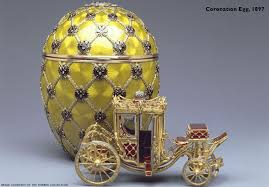

Image result for faberge egg  Image result for faberge egg


I find it fascinating how the human race can find a way to take one symbol, and convert it into a symbol of something very, very different.


We do this all the time, more than we realize.  We have converted the education system into a hyper competitive, global business. Family farms have been converted into corporate giants driven by insane profits (at the expense of our health). We converted the music, entertainment and sports worlds into billion dollar enterprises. In my own lifetime, we went from “no Super Bowl” to the largest media event in the world. 

Name a famously rich person. Did they cure cancer or do something amazing to eliminate suffering in the world? Or did they star in hit action movie, or can they dunk a basketball better than most?

Give us just a few years, and we can take just about any symbol (no matter how pure, no matter how honorable) and tweak it and twist it until it becomes unrecognizable - and - watch it become the opposite of its original purpose.

Can you find the “Hidden Easter Egg” in this blog?

Happy Easter Everyone!

Sunday, February 28, 2016

Work In Progress

hqdefault.jpg


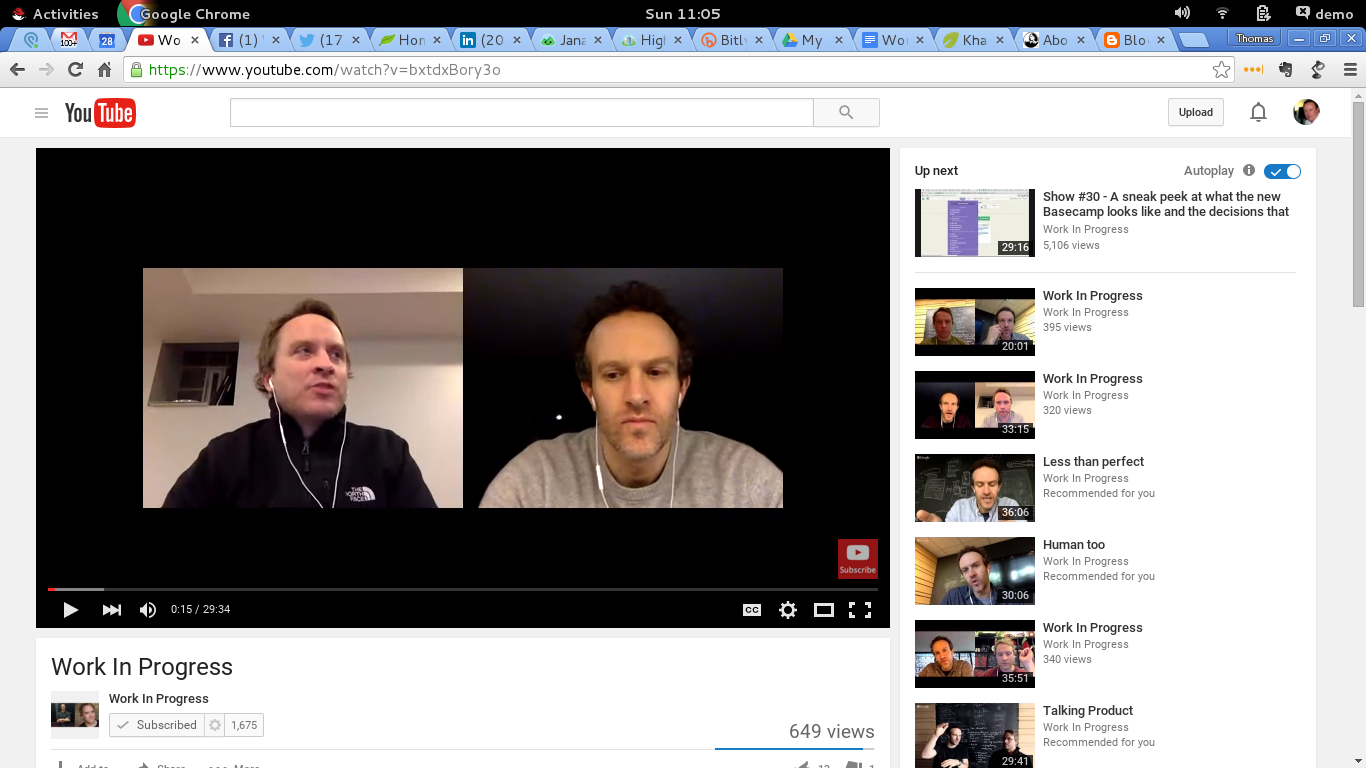
Jason Fried, founder and CEO of Basecamp (basecamp.com), and Nathan Kontny, CEO of Highrise (highrisehq.com), talk about the challenges of running a business, product design, and whatever else we're going though. Have something you'd like us to talk about? Let us know on Twitter twitter.com/jasonfried & twitter.com/natekontny.
***********
OK, full disclosure. I am a huge fan of both Jason and Nate, and I run multiple global companies via Highrise, Basecamp and a few 3rd party apps that make their tools even more powerful.


Via their YouTube Channel Work In Progress, they have (with amazing generosity) posted hundreds of hours of “here’s how we do it” explainer videos - all for free.


The future of work is remote. Global collaboration via “the cloud” and the IoT (Internet of Things) is a way of life. Lifelong education is now expected. We live in the world of TED.com Ed.Ted.com and of course the amazing Khanacademy.org.


Remember this big news from last year?


Mountain View, Calif. – April 9, 2015 – LinkedIn (NYSE:LNKD), the world’s largest professional network on the Internet with more than 300 million members worldwide, today announced that it has entered into an agreement to acquire lynda.com, a leading online learning company teaching business, technology and creative skills to help people achieve their professional goals. Based in Carpinteria, CA, lynda.com was co-founded in 1995 by Lynda Weinman and Bruce Heavin. The transaction is valued at approximately $1.5 billion, subject to adjustment, in a combination of approximately 52 percent cash and approximately 48 percent stock.


Lynda.com (Our mission)
To help you learn the skills you need to achieve your full potential.

About us
Lynda.com is a leading online learning company that helps anyone learn business, software, technology and creative skills to achieve personal and professional goals. Through individual, corporate, academic and government subscriptions, members have access to the lynda.com video library of engaging, top-quality courses taught by recognized industry experts.

At the NYDLA.org we say: From Distance Learning to Digital Learning to Digital Living to the IoT (Internet of Things) to “The Cloud” - no matter what labels we use, the NYDLA.org aims to be the premier remote work, distance/digital learning and collaboration association in the United States and beyond. Whether it is via satellite, video conferencing, online, offline or other means of distribution, NYDLA will provide the latest information about technology development, collaboration, design and application in our at anytime, anywhere global collaboration world. Join the NYDLA.org as we help each other to live, learn, work and play in the clouds!

Well played, Jason and Nate. Well played.

Screenshot from 2016-02-28 11:05:48.png

Sunday, February 21, 2016

May the diabetes be with you!

IMG_20160221_101141.jpg


I don’t browse. Send me to the grocery store for milk, eggs, bread, and I’m in and out in minutes. I’m a man on a mission!


Last night on the way home from the movies, we stopped at the local grocery store around eight minutes before closing.  NO PROBLEM! Speed shopping is my super power!


Taking a shortcut down the cereal aisle, there it was. The Box. A box of candy on the shelf where you are supposed to find cereal. I stopped, frozen. The clock was still ticking - the store closes at 10pm. But I could not move.


Why are they selling candy in the cereal aisle? No, wait. They are selling toys? They are selling toys AND candy - in the cereal aisle. What the hell is going on here?
IMG_20160221_101048~2.jpg


Star Wars toys - in a box of candy - in a cereal box. I must investigate!  I’m buying this box and taking it home with me - for science!


Hershey’s Cocoa & Reese’s Peanut Butter Sweet and Crunchy Corn Puffs!


An EXCLUSIVE Droid Viewer is inside the box!  And, in case you are looking for a new hobby, there are SIX to collect, including BB-8! 

OMG! I love, LoVe, LOVE BB-8!


Wow. Marketing GENIUS. From the side of the box: “WE BELIEVE IN THE GOODNESS OF WHOLE GRAIN CEREAL. Cereal is packed with nutrients and contains complete grains, which can help fuel your morning ~ General Mills.


Now, if you are grocery shopping, and you have your child in the cart and you drive down the cereal aisle, you are nuts. If you go anywhere NEAR the cereal aisle, you are activating the launch sequence of screaming child tantrum DEFCON 5. There should be warning signs like on a ski slope: this is a BLACK DIAMOND aisle. FOR ADULTS ONLY!


Who is the marketing genius behind this strategy? And, if you buy ONE box, you need to buy five more boxes, right? If you are not going to complete the collection of six droid viewers, the FORCE will NOT be with you!


Now here is my final question: if you go down the cereal aisle as an adult shopper WITHOUT a screaming child in your care, and you STILL walk out of the store with this (Candy - Toy - Healthy, Nutritionally Focused Cereal) purchase, you are:


  • A STAR WARS action figure collector
  • Someone who wants diabetes (for you or your child)
  • You need material for your Sunday blog


Marketing. It’s good for ya.

IMG_20160221_101104.jpgIMG_20160221_101130.jpg

Sunday, February 7, 2016

If it ain't broke, you must have fixed it

NewManagement_3D-232x300.png


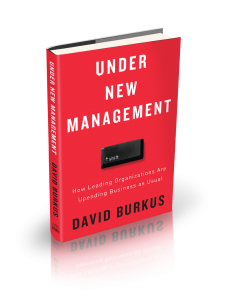
Under New Management: How Leading Organizations Are Upending Business as Usual

One of the perks of running the NYDLA.org is receiving advance copies of really cool books.


I stumbled across David Burkus during our recent winter storm Jonas (Snowzilla) which gave me an excuse to get caught up on my reading (and listening) to podcasts and books. Like finding a secret room full of hidden treasures, I discovered David’s archive of podcasts.


I used the storm as ground cover to explain to my wife why I listened to dozens of podcasts in a matter of days. David’s podcast archive is like a Hall of Fame of thought leaders and brilliant minds from the world of business and leadership.


I’m all about remote work, distance learning, technology based learning systems (TBLS) and the future of work. When you visit www.DavidBurkus.com the first thing that you see is the question: How Can I Help You?  


Oh let me count the ways…...


In his new book, David explores:


  • Do open-floor plans really work – or do they make employees miserable?
  • Are there companies which really put their employees’ welfare first, and their clients second?  
  • Are annual performance reviews really necessary?


Dr. David Burkus is a highly regarded and increasingly influential business school professor who challenges many of the long-established principles of business management. Drawing on decades of research, David has found that not only are many of our fundamental management practices wrong and misguided, but they can be downright counter-productive.


Today, the best companies around the world are breaking the old rules. At Volkswagen, email is now restricted to certain hours, so that employees can work without distraction. Netflix no longer has a standard vacation policy of 2-3 weeks, but instructs employees to take off as much time as they feel they need. At Morningstar Farms, there are no managers at all - the employees govern themselves. At Zappos, new employees are given the option to quit and get paid for it.


Under New Management reveals how companies leave behind decades-old management practices and implement new ways to enhance productivity and morale. This new book challenges the traditional and widely accepted principles of business management — and proves that they are outdated, outmoded, or simply don’t work.


*******


We live in the world of distance learning, TED.com and ebooks. We live in the world of global collaboration, telemedicine and “the cloud”. I just learned that for the first time, you can go to a local cinema and watch the opening session of the legendary TED Conference on the big screen.


ted-live.jpg


After listening to my marathon of Snowzilla enabled podcasts, I connected with David via LinkedIn, and mentioned how we know many of the same people from the world of business and higher education.


Next thing you know, I am reading an advanced copy of his new book. And now, after being blown away by his newest best selling book (trust me) I am knocking out this blog before heading off to our Super Bowl party. I hope that David approves.


Don’t wait for the next Snowzilla. Go checkout www.DavidBurkus.com and make sure you read his new book once it comes out next month.


David’s websites says: How can I help you?


Leaders are Teachers.


I think his website should be updated to: How can I help you to help yourself?

Sunday, January 31, 2016

Uber me baby!


I attended the National Retail Federation “BIG SHOW” earlier this month at the Jacob K. Javits Convention Center in New York City.


NRF's 105th Annual Convention & EXPO was an amazing event. There were more than 33,500 attendees, hundreds of sessions, miles of EXPO, technologies to boggle the mind and so much more.


Retail sales workers include both those who sell retail merchandise, such as clothing, furniture, and automobiles, (called retail salespersons) and those who sell spare and replacement parts and equipment, especially car parts (called parts salespersons). Both types of retail sales workers help customers find the products they want and process customers’ payments.


Last year (2015) in Retail:
Median Pay was $10.42 per hour / $21.6780 per year
Number of Jobs (Retail Sales Workers) was 4,859,600
Job Outlook: +7% (As fast as average)


According to the NRF, employment of retail sales workers is projected to grow 7 percent from 2016 to 2024, about as fast as the average for all occupations. Many workers leave this occupation, which means there will be a large number of job openings.


Did you catch that? Many workers leave this occupation, which means there will be a large number of job openings. People don’t leave a good thing.


Hertz never saw Zipcar coming; Zipcar never saw Uber coming.
Hilton and Marriott never saw AirBNB coming.
NBC, CBS, ABC (the big three) never saw HBO, Netflix and Hulu coming.
The National Retail Federation (with 105 years of wisdom) never saw Amazon.com coming.


Last night my son and I (finally) saw the new Star Wars movie in IMAX 3D. Tickets were $20 each, plus snacks. Normally we wait to watch most hit movies at home - unless it is a movie that “requires” the IMAX 3D experience. My living room with a big screen TV is usually just fine for movie watching (at a fraction of the price). We bought our Star Wars tickets in advance, online with a smartphone. Self-service, thanks to the cloud.


Before the movie, we stopped at Red Robin (for an adult beverage). It was self-service via a new fancy restaurant kiosk. So basically, we drank beer and then gave a 20% tip to a droid.
Image result for red robin self service restaurant kiosk

Our local grocery stores all have self-service checkout as a option. Our local CVS and Walgreens drug stores now have “minute clinics” where you can use Telemedicine (powered by IBM Watson) to perform self-service medical exams, diagnosis and even write prescriptions - all without a “live” medical expert.


In our household we are “power users” of Amazon Prime with free 2nd day shipping. We try to buy everything that that is non-perishable (dog food, paper goods, canned goods, soap, etc.) online with convenient, automatic delivery right to our door. Our local grocery store (Kings) is not known for having low prices. Eggs, milk, bread - anything with an expiration date - we go to Kings. You would be crazy to buy batteries, cereal or tuna fish at Kings. All Hail Amazon Prime!  I just learned that the USPS shall start making Sunday deliveries for Amazon Prime, so that is now a 7 days a week service, including holidays. The world of business has invented new verbs in the past few years.  Blockbuster was “Netflixed” <verb> and went out of business. Yellow Cabs have lost business to Uber and Lyft. Formal education and training have now been “Khanned” by Khan Academy.

We shop, research, browse, buy and consume all manner of goods and services via the cloud and the IoT (Internet of Things). Once again: the NRF stated at the show: Job Outlook: +7% (As fast as average). Retail sales workers help customers find the products they want and process customers’ payments. How can job growth in retail be growing at 7% when every day we see technology popping up to do MORE business with LESS people? Why is big business so keen on automating the entire retail process? 


If the number of jobs (Retail Sales Workers) was 4,859,600 in 2015, there is NO WAY this number is going to increase at 7% with all of these self-service tools becoming more and more popular. New Jersey is one of the few states where it is “illegal” to pump your own gas. So, I guess those jobs are still safe - for now.


In the end, what are the things that humans can just do better than apps or kiosks?

Technology lacks flexibility. When we’re interacting with a person and we’re having trouble understanding something, the person can adjust to us. If we’re having a misunderstanding, they can help clarify it. Technology really can’t do either of these things. A person has the ability to delight us or disappoint us. It’s really hard for a technology to ever delight, however, because it’s standardized and is built on a set of rules. But it is possible for technologies to disappoint us.

The video below talks about how the future of retail is “bright” but not for everyone. Retail sales workers who help customers find the products they want and process customers’ payments - your future is very cloudy.